


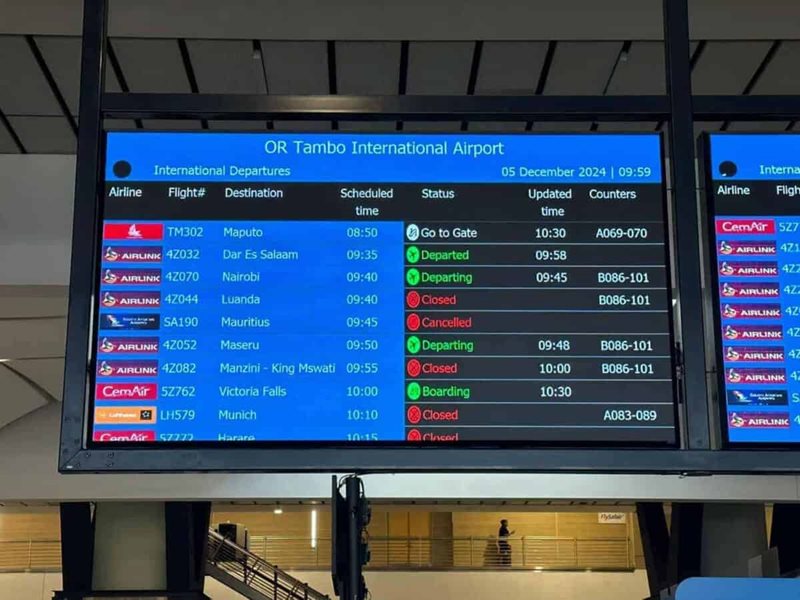
NATIONAL NEWS - An Air Traffic & Navigation Services (ATNS) insider has revealed that the crippling delays experienced at OR Tambo International Airport on Sunday, and their hangover into Monday morning, were set in motion by something that should never be able to compromise a national airspace system – one person allegedly called in sick.
The source told The Citizen that ATNS was unable to raise back-up staff to prevent big delays at the country’s busiest airport.
Inclement weather later in the day further compounded the backlog.
Reported staffing failure caused widespread OR Tambo delays
“There was nobody willing, nor able, to pick up the slack,” the source said. “And there was no back-up plan for peak holiday traffic into OR Tambo.”
ATNS issued advisories relating to both human resource shortages and later severe weather. Spokesperson Mphilo Dlamini said there was an important distinction between outbound delays and inbound diversions.
Dlamini said outbound flight delays were caused by HR constraints, while diversions from landing at OR Tambo were due to severe afternoon thunderstorms.
ALSO READ: OR Tambo flight delays: Severe thunderstorms to blame, ATNS says
“It is important to clarify that, because some stakeholders were issuing statements to the effect that the diversions were caused by staff shortages, which is not true,” Dlamini said.
But he did not confirm or deny the allegation that the absence of a single member of staff triggered the initial chaos.
Aviation consultant Sean Mendis said there was no excuse for delays caused by staffing failures.
No excuse for delays caused by staffing failures
“ATNS has lost the plot with regard to its primary mission of managing national airspace.
“If they were halfway competent, these problems would never have been allowed to arise in the first place. Crisis mode has become the default across much of South African aviation,” he said.
While passengers were stranded and rerouted, airlines incurred significant additional fuel burn, crew duty extensions and knock-on operational losses.
ALSO READ: ATNS: Bonuses in sky, safety on ground
Flights were diverted to Durban and Gaborone. Airlink confirmed that 31 of its flights experienced delayed departures at OR Tambo directly attributable to ATNS staffing shortages and flow control measures.
This sparked a further 69 knock-on delays across its national network. In total, 99 of Airlink’s 204 scheduled flights, nearly half of its daily operation, were delayed.
Cemair reported similar network-wide delays, also attributing them to ATNS staff shortages.
69 knock-on delays across its national network
The country’s largest domestic operator, FlySafair, did not respond to questions by the time of publication.
Lift Airlines confirmed its operations were affected, with several scheduled flights delayed and at least one diverted to an alternate airport.
He said the situation was further compounded by inclement weather and failures in Airports Company South Africa’s baggage reconciliation systems.
Cilliers Jordaan, chief commercial officer at Lift, said ATNS had advised operators that morning of resource constraints.
ALSO READ: Five things you need to know at the start of the year
“The combination of these factors resulted in reduced operational capacity and knock-on effects across flight schedules and aircraft rotations,” Jordaan said.
Organisation Undoing Tax Abuse chief executive Wayne Duvenage said the rationing of airspace at OR Tambo was a national red flag, pointing to systemic skills shortages, weak workforce planning, failures in succession management and inadequate oversight by the ATNS board and the department of transport. Mendis said: “ATNS is unfit for purpose, with the SA Civil Aviation Authority sometimes teetering on the same precipice.
Airspace at OR Tambo was a national red flag
“They have lost skilled controllers to Australia and the Middle East, hollowing out institutional resilience. They can barely cope in perfect conditions and collapse in suboptimal ones.”
This comes as ATNS paid more than R130 million in performance bonuses over the past two financial years, during a period in which more than 200 instrument flight procedures were suspended amid a steady exodus of controllers and procedure designers.
Financial statements show roughly three-quarters of ATNS’ pre-tax profit in each of the years was consumed by bonuses, including payments to senior execs.
NOW READ: BMA intercepts suspected human trafficking at OR Tambo International Airport
Article: Caxton publication, The Citizen
‘We bring you the latest Garden Route, Hessequa, Karoo news’