


OUDTSHOORN NEWS - The nationwide anti-immigration campaign on Tuesday 30 June caused minimal disruption in the Greater Oudtshoorn area, although the police remained on high alert amid concerns over possible unrest.
Several foreign-owned spaza shops had closed temporarily as a precaution to protect the owners and their businesses, while the Oudtshoorn and Dysselsdorp police maintained a visible presence to prevent incidents of looting and public disorder.
Although several arrests of suspected illegal immigrants have reportedly been made in the area since last week, the official number has not yet been confirmed.
According to police spokesperson Lieutenant Colonel Malcolm Pojie, it would be premature to release any figures at this stage. "A consolidated report will be made available by the national police at a later stage," he said.
Oudtshoorn Courant has, however, learnt from reliable sources that several foreign nationals of various nationalities have been arrested since last Friday. Two residents were also arrested in Dysselsdorp on charges of business robbery in connection with the alleged looting of foreign-owned shops.
The campaign against suspected illegal immigrants has drawn mixed reactions from local communities. The residents in neighbourhoods in which many foreign-owned shops are operated said the businesses play an important role by providing affordable groceries and essential goods.
In Rose Valley, several residents expressed their concern over the temporary closure of the shops.
"At these shops, we can buy bread for R10 and sugar for R2. We can't do that at the bigger stores, and those shops are far from where we live. We also don't have money for transport," one resident said.
 The police intervened at a foreign-owned shop in New Look, Bongolethu, after some residents had allegedly began looting the premises. Photo: Supplied
Ethiopian community speaks out
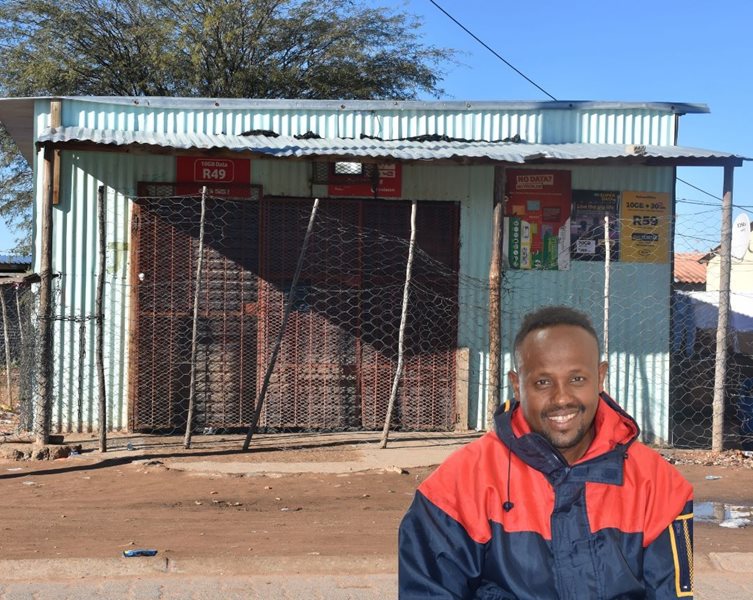
The paper also spoke to Ethiopian community leader Alemayehu Lodamo, better known as Alex, who has lived in South Africa for 13 years. Lodamo owns two shops in Oudtshoorn and holds a Bachelor of Science Degree in Environmental Health from the University of Gondar in Ethiopia.
According to him, four foreign-owned shops in Oudtshoorn were looted during the unrest, one in Bridgton, one in New Look, Bongolethu, one in GG Camp and one in Rosebank, as well as two others in Dysselsdorp. He also alleged that one shop owner was injured from being struck by stones. He said these incidents have been reported to the police.
"I do have to add that the local people tried to stop the looters and protect our shops, and we are very grateful for that."
Lodamo said many Ethiopian nationals living in the area fled the conflict and war in their home country and entered South Africa as refugees in search of safety and better opportunities.
He explained that refugee permits fall in two categories, Section 22 and Section 24. A Section 22 permit is a temporary document issued to an asylum seeker and a Section 24 permit is the formal refugee permit granted once an asylum claim is officially approved.
According to Lodamo, refugee permits can only be renewed at five refugee reception offices across the country, requiring many people to travel long distances. Although some renewal processes had become available online after the Covid-19 pandemic, he described the system as slow and cumbersome, and applicants often wait long periods of time for their documents to be renewed.
"We come to South Africa with nothing and nowhere to go, because we are looking for a better future and a safer place to live for ourselves and our families. I have a university degree and worked for the Ethiopian government, but I cannot use my qualifications, because I am not a South African citizen," he said.
He added that, unlike many countries, South Africa does not accommodate refugees in formal refugee camps. "Because of that, many of us start by selling goods such as bedding and curtains door to door. Once we have saved enough money, we open small shops to support our families. Criminal activities such as looting have a devastating financial impact on us."
Lodamo said most foreign communities in South Africa have elected community leaders who encourage members to comply with South African laws.
"We make sure our people respect the laws of this country. We do not deny that there are illegal immigrants involved in criminal activities, but they do not represent all of us, and we do not support their actions. If someone commits a crime, they must face the consequences, whether that means imprisonment or deportation. We try to live peacefully and show respect to everyone, regardless of race or nationality."
‘We bring you the latest Garden Route, Hessequa, Karoo news’