

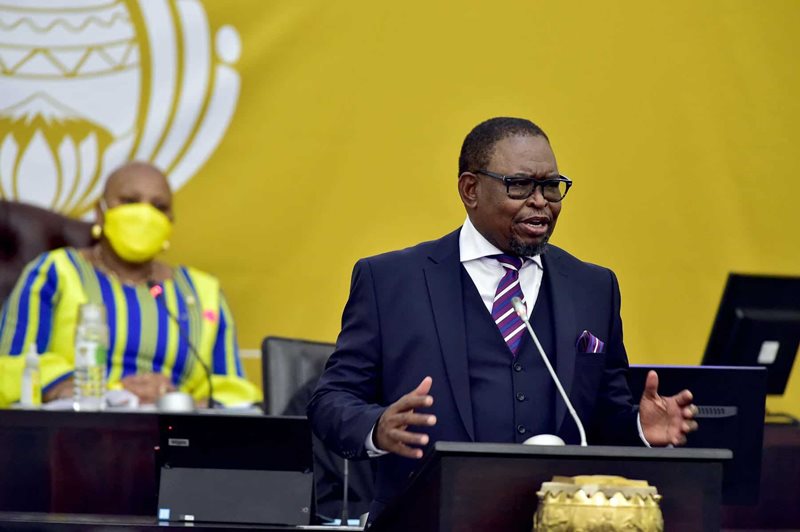
BUSINESS NEWS - Finance Minister Enoch Godongwana delivered the statement in Parliament on Wednesday, 21 October, outlining government’s fiscal priorities for the medium term amid global economic uncertainty and continued pressure on public finances.
The updated fiscal framework reflects stronger-than-expected revenue collections, efforts to curb wasteful expenditure and plans to direct more funding towards infrastructure, essential services and economic growth.
Tax revenue forecast increases by R17.1bn
South Africa’s gross tax revenue forecast for the 2026/27 financial year has been revised upwards by R17.1 billion compared with the February estimate.
The improvement is supported by stronger collections from corporate income tax, dividends tax and Value-Added Tax (VAT), as well as higher commodity prices. However, Treasury cautioned that some of these gains are expected to dissipate over the medium term.
Gross tax revenue is projected to increase from R2.14 trillion in 2026/27 to R2.53 trillion in 2029/30.
Petroleum royalties have also been revised upwards by approximately R6.8 billion, while departmental revenue is expected to increase by R14.3 billion.
According to the National Treasury, total tax and non-tax revenue and National Revenue Fund receipts are R54.1 billion above the estimates presented in the 2026 Budget.
READ MORE: Godongwana reduces fuel levy until January: Here's by how much
The stronger revenue outlook provides some additional fiscal room, including funding for infrastructure projects, disaster-related expenditure and a larger contingency reserve.
The South African Revenue Service (SARS) is also continuing to strengthen tax administration and compliance, while stepping up efforts to combat the illicit economy, particularly illegal alcohol and tobacco trading.
Customs and excise modernisation, enhanced cargo scanning, track-and-trace capabilities and stronger enforcement are among the measures being used to disrupt illicit trade.
Government targets R38.1bn in savings
Government has identified a further R38.1 billion in savings over the 2027 Medium-Term Expenditure Framework (MTEF) period, in addition to the R12 billion identified in the 2026 Budget.
The savings form part of a broader effort to improve public spending and redirect resources towards programmes that deliver measurable results.
The identified savings include:
- R11.7 billion from low-priority programmes, reduced duplication and administrative efficiencies in national departments.
- R13 billion through measures to reduce fraud in social grants.
- R7.8 billion from the human settlements development grant, where inefficiencies and rent-seeking have affected housing delivery.
- R5.5 billion from surpluses held by public entities.
Treasury said the approach involves reviewing programmes to determine whether they remain necessary, align with policy priorities and deliver value for money.
Programmes that are underperforming or no longer fit for purpose are being restructured or phased out, while administrative inefficiencies and fraud are being targeted.
The objective is to improve the quality of public expenditure rather than simply reduce budgets across the board.
Debt reduction remains a priority
National Treasury is aiming to reduce South Africa’s debt-to-GDP ratio over the remainder of the decade by strengthening the primary budget surplus and narrowing the deficit.
Government reported that gross debt stabilised at 78.4% of GDP in 2025/26.
The main budget deficit is forecast to narrow from 3.7% of GDP in the current financial year to 2.5% in 2029/30.
Treasury said lower debt levels would help reduce borrowing costs and improve investor confidence, potentially supporting higher public and private investment, economic growth and job creation.
Debt-service costs remain a significant pressure on public finances. Although these costs are projected to decline to an average of 20.6% of main budget revenue over the MTEF period, they continue to absorb a substantial share of government revenue.
Government also intends to introduce a principles-based fiscal anchor to strengthen long-term fiscal sustainability and provide a framework for managing public finances.
Infrastructure investment tops R207bn
Infrastructure development remains central to government’s plans to stimulate economic activity, expand productive capacity and improve public services.
The Infrastructure Finance and Implementation Support Agency (IFISA), which began operating on 1 April 2026, is supporting projects across all spheres of government with a potential investment value exceeding R207 billion.
The agency is intended to improve project preparation, mobilise private-sector capital and expertise, and accelerate the delivery of infrastructure projects.
Government is also advancing public-private partnerships (PPPs), particularly in municipalities facing infrastructure backlogs and service delivery challenges.
Of the 68 projects currently in the PPP pipeline, 31 are municipal projects.
Amended Municipal PPP Regulations have been submitted to Parliament for the required 30-day scrutiny period, representing the final step before implementation, according to the Minister.
The reforms are intended to simplify procedures, reduce transaction costs and make it easier for municipalities to partner with private businesses in delivering infrastructure and services.
The Budget Facility for Infrastructure has approved more than R100 billion in fiscal support, while the infrastructure bond has raised more than R14 billion since its first issuance in December 2025.
Treasury is also reviewing infrastructure conditional grants to improve planning, accountability and oversight. Between 2017/18 and 2023/24, national government transferred R887 billion through these grants to provinces and municipalities.
Despite the substantial investment, Treasury said projects have often been delayed, left incomplete or failed to deliver their intended benefits. The reform process aims to ensure that funding translates into completed projects, functioning infrastructure and reliable services.
Additional spending targets disaster relief, public services and crime
Despite its focus on fiscal discipline, government has made provision for additional expenditure during the 2026/27 financial year.
The 2026 Adjustments Appropriation Bill proposes an upward expenditure adjustment of R10.6 billion. This includes R1.9 billion in rollovers from the previous financial year and R6.2 billion for unforeseeable and unavoidable expenditure, mainly disaster relief and rehabilitation.
A further R2.2 billion is allocated for early-retirement and voluntary-exit packages for qualifying public servants.
The adjustments also include:
- R823 million for the South African National Defence Force to deploy troops in support of police operations against gang-related crime and illegal mining.
- R516 million for the Madlanga, Khampepe and Nkabinde commissions of inquiry.
- R4.3 billion in self-financing expenditure.
A separate Special Appropriation Bill is also proposed, providing R6.9 billion, mainly for SARS.
Government will allocate R10 billion of the in-year revenue overrun to the contingency reserve to help manage the El Niño response and other risks. The remaining amount is provisionally earmarked for infrastructure projects being evaluated by the Budget Facility for Infrastructure.
An additional R150 million has been allocated to strengthen the technical capabilities of the digital services unit responsible for developing the MyMzansi app, which is intended to provide citizens with access to government services through a single digital platform.
A further R20 billion has been earmarked for infrastructure projects currently under evaluation by the Budget Facility for Infrastructure.
What the budget means for business and the economy
The MTBPS sets out a strategy aimed at balancing fiscal discipline with investment in economic growth.
For businesses, the improved tax revenue outlook and commitment to debt stabilisation may support confidence in the country's public finances. However, the extent to which this translates into stronger investment and job creation will depend on sustained revenue performance, effective spending reforms and the implementation of infrastructure projects.
The emphasis on public-private partnerships could create opportunities for private-sector participation in infrastructure development, particularly in municipalities and sectors where public funding and implementation capacity are constrained.
At the same time, the focus on tax compliance and enforcement against illicit trade signals continued pressure on businesses and individuals to meet their tax obligations.
For households and communities, the effectiveness of the savings programme will be measured by whether resources are redirected towards better public services, improved housing delivery and functioning infrastructure.
Treasury's challenge is to turn higher revenue collections and identified savings into tangible economic benefits while reducing the cost of servicing public debt.
The MTBPS therefore places implementation at the centre of government’s fiscal strategy: spending more effectively, maintaining existing infrastructure, attracting private investment and ensuring that public funds deliver measurable outcomes.
The medium-term outlook will depend not only on the government's ability to collect revenue and contain expenditure, but also on whether these measures translate into stronger economic growth, sustainable public finances and improved service delivery across South Africa. - SAnews.gov.za
‘We bring you the latest Garden Route, Hessequa, Karoo news’